The portal checks your file's format. We check whether it's right.
Refresh 31 put every MAS SIN on monthly TDR. GSA's portal validates format and accepts your file — then an Industrial Operations Analyst reads what's actually in it. We check that first: IFF, TAA, thresholds, clauses — before you submit. TDR Guard and FAR Guard are in early access.
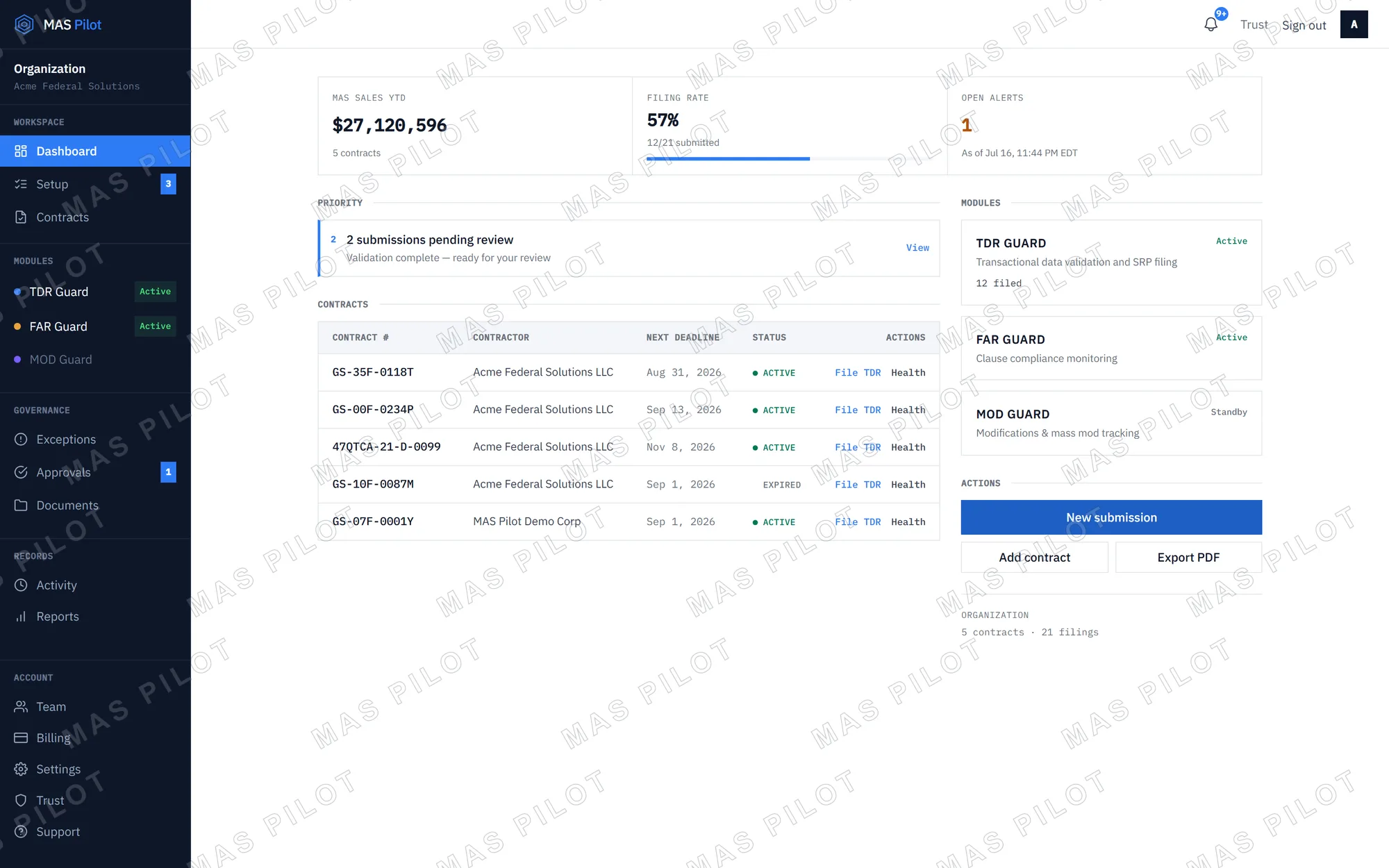
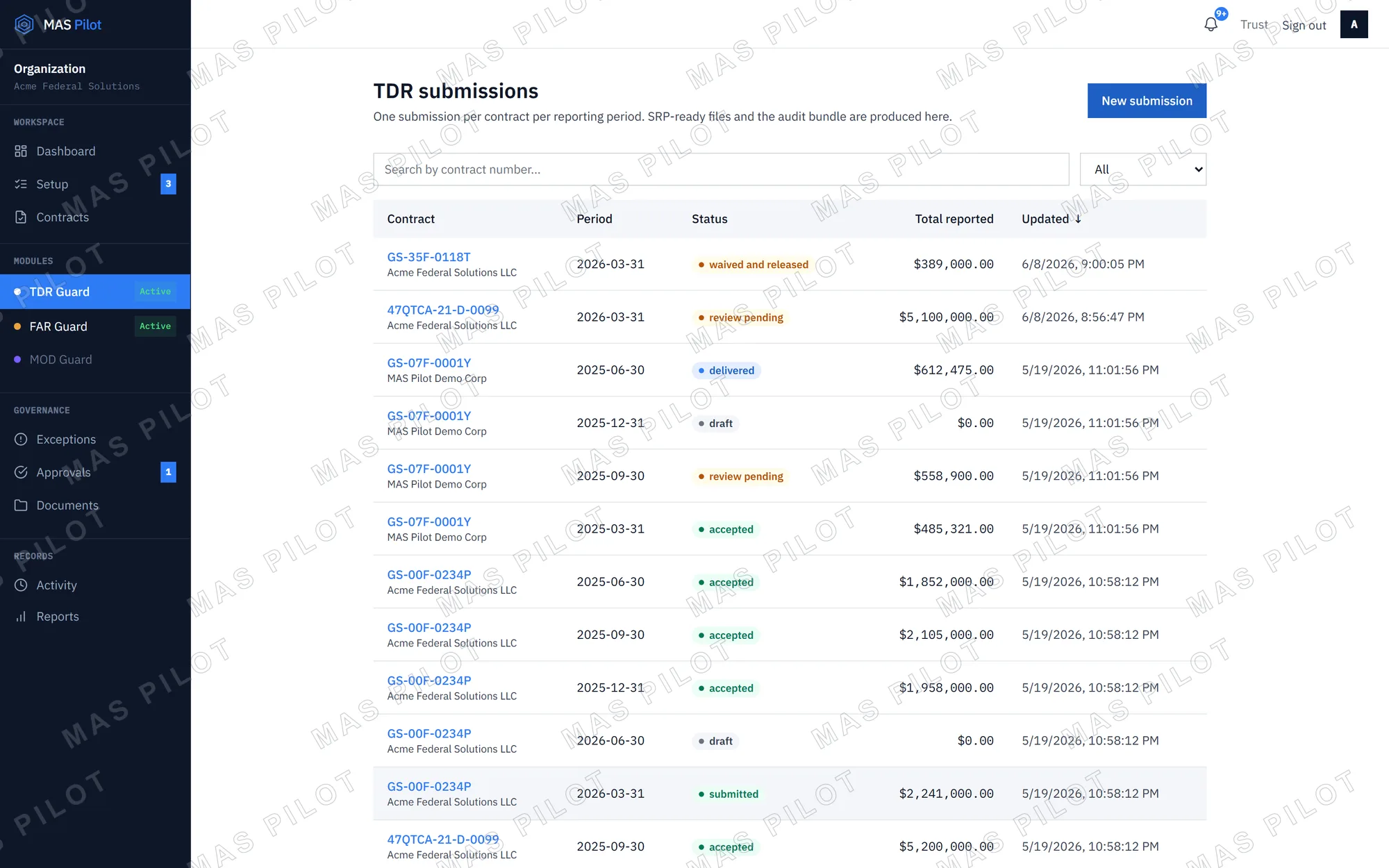
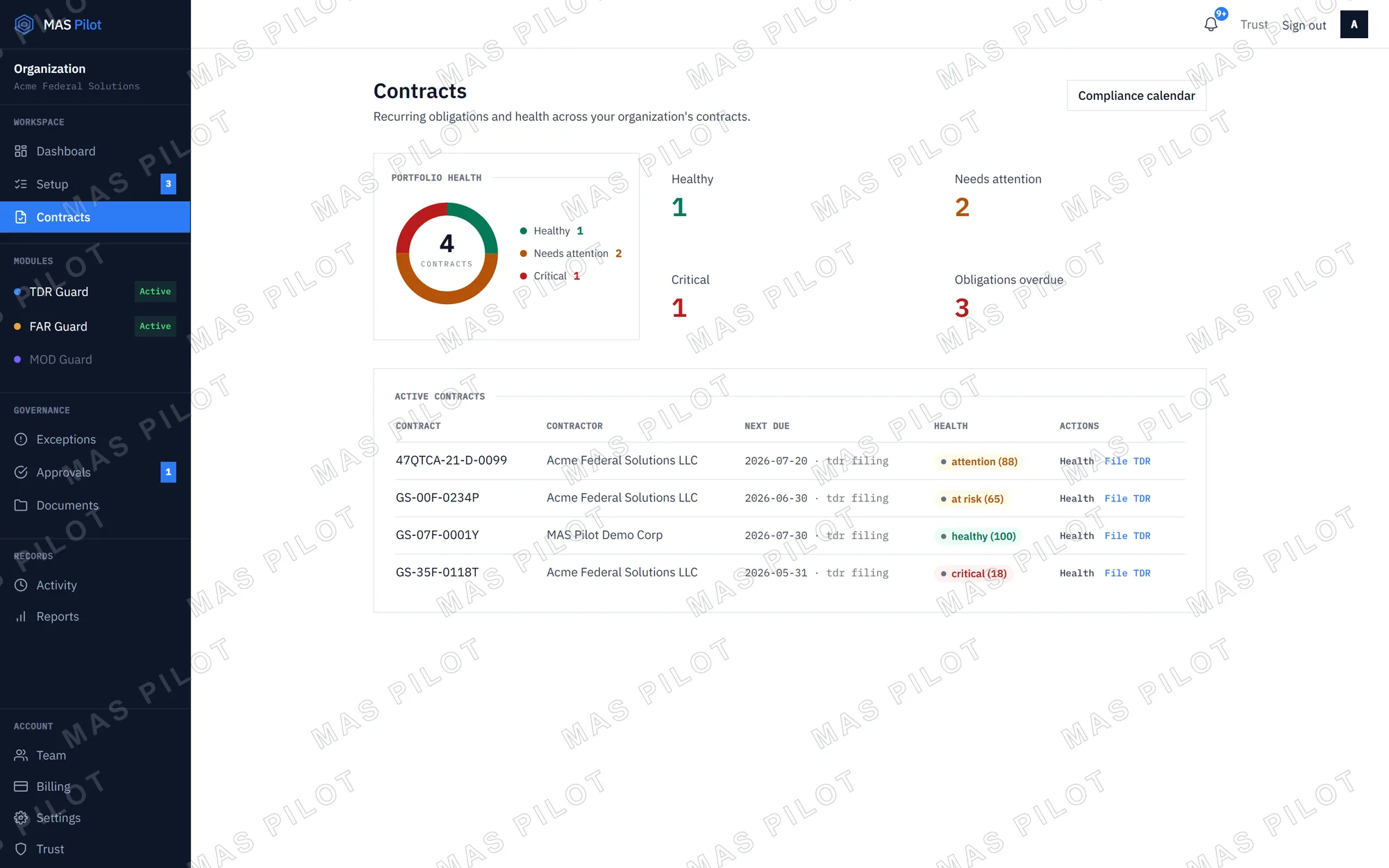
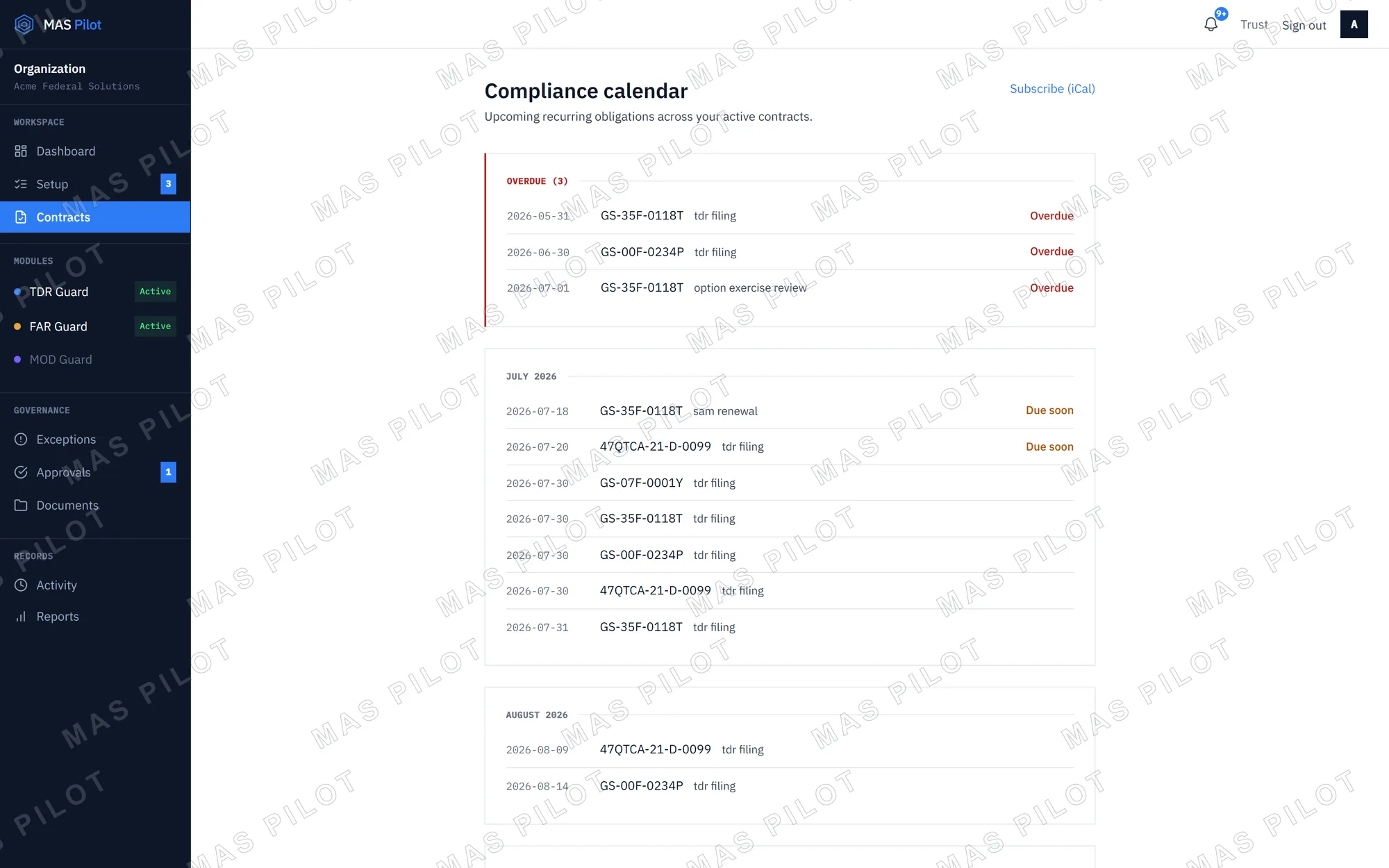
A file the portal accepts isn't the same as a compliant one.
GSA's Sales Reporting Portal validates format and will hard-reject bad fields. But IFF math, TAA and country-of-origin, sales thresholds, and clause applicability pass straight through it — and surface later, in a Contractor Assessment Visit, an option-year review, or a resubmission.
Is the free SRP enough? See the two layers → Source: GSA.gov — TDR Policy →IFF errors the portal accepts
A wrong fee calculation clears the SRP's format check and surfaces in an IOA review.
Threshold & SIN risk
The $100K / $125K floors and wrong SIN mapping affect your contract standing.
TAA & country-of-origin exposure
Format-valid lines can still carry non-compliant country data a review may flag.
Clause & Mass Mod drift
FAR/GSAM clause gaps and late modifications quietly erode compliance.
The portal validates the file. We validate the filing.
Start with TDR Guard.
Built for the monthly reporting cycle.
How it works
Software checks every line. A person checks the calls that matter.
Every transaction is validated automatically the moment you upload — instantly, no queue. Only genuinely high-risk items escalate to a credentialed federal-acquisition reviewer. The routine lines never touch a human, and neither does your deadline.
Software-first, always
Every line runs through automated checks on upload — IFF math, thresholds, field completeness, clause flags. Instant, on every file.
Escalation, not manual review
Only borderline IFF, TAA, and threshold or clause calls reach a person — the judgments software shouldn't make alone.
You stay the contractor of record
Accept or waive every finding. You sign the submission; GSA makes every determination. No black box.
One platform. The full MAS lifecycle.
Automated Transactional Data Reporting support for MAS schedule holders. Checks every required TDR data element, including the fields added in Refresh 31, calculates IFF at the rate in effect (currently 0.75%) for contractor review, generates a pipe-delimited SRP export for contractor review before submission, and surfaces monthly deadlines. Contractor remains responsible for submission accuracy under GSAR 552.238-80 (DEC 2025 deviation).
- →All required TDR data elements checked
- →IFF calculated per period, remittance tracked quarterly
- →TAA review support when country-of-origin or catalog data is provided
- →SRP export generated for contractor review before submission
- →$100K / $125K threshold monitoring — contract risk flagged
- →Amendment and correction support
FAR/DFARS/GSAM clause analysis, SAM.gov monitoring, CAV prep, and compliance scoring. The compliance engine embedded across all MAS Pilot products.
- →Clause gap analysis
- →SAM.gov registration expiration alerts
- →Mass Modification tracking
- →CAV preparation checklist
Contract modification drafting support, documentation packages, and cover-letter drafts for contractor review and signature. EPA calculations and justification narratives.
- →Drafting support across modification types
- →EPA calculation support
- →Submission documentation packages
Complete MAS schedule offer package assembly. SIN selection, pricing strategy, FCP catalog checks, and eOffer workflow guidance for firms pursuing a Schedule award.
- →Offer preparation assessment
- →FCP catalog checks
- →eOffer submission workflow guidance
Designed for sensitive contractor data.
These describe our security-by-design approach. Some platform controls (e.g., MFA, audit logging, SOC 2) are targeted for general availability, not yet live — see the Security page for what is live today versus planned.
Built for the system it serves.
The MAS program repeats the same failure every month: contractors run mandatory reporting from spreadsheets and find out about problems only after GSA does. The agency's own Inspector General put a number on the result — 73% of FY25 TDR-reported sales were unusable for price analysis.[1]
MAS Pilot is built to catch those problems first: a compliance engine that checks the work, while the contractor stays responsible for every submission and GSA makes every determination.
Refresh 31 made the deadline real.
TDR, Refresh 31, and MAS Pilot — quick answers
What is Transactional Data Reporting (TDR) for GSA MAS contractors?
TDR requires GSA Multiple Award Schedule contractors to report transactional sales data — a defined set of data elements, expanded under Refresh 31 — for orders under their MAS contract. Under Refresh 31, TDR is mandatory for every MAS SIN.
What changed in GSA MAS Refresh 31?
Refresh 31 (released April 2, 2026) made TDR mandatory for all MAS SINs, eliminated the Price Reductions Clause, removed CSP-1 disclosure requirements, and added AI acquisition clauses. The solicitation changes came via Mass Mod A914; non-TDR contractors transition via Mass Mod A909, which has a 60-day acceptance window.
What is Mass Mod A909 and what happens if I don't accept it?
Mass Mod A909 is the system-generated modification that transitions non-TDR contractors to mandatory TDR. GSA directs contractors to accept it no later than 60 days after receipt. Contractors who do not accept in time can have their contract removed from GSA Advantage, eLibrary, and eBuy. Acceptance is two steps — A909, then a separate Participate in TDR modification. TDR takes effect on the first day of the sales-reporting quarter after acceptance. Contractors who accepted on or before June 30, 2026 are effective July 1, 2026, with a grace period through December 31, 2026 and the first monthly report due August 30, 2026. Later acceptance moves the effective date to a following quarter, but the grace period still ends December 31, 2026, and beginning January 1, 2027 compliance is subject to enforcement by the Contracting Officer.
What is the current IFF rate and how is it paid?
The Industrial Funding Fee is currently 0.75% of MAS sales. It is calculated on reported sales and remitted quarterly via Pay.gov. Contractors remain responsible for the accuracy of IFF calculations and remittance.
What are the GSA MAS minimum sales thresholds?
$100,000 in total schedule sales across the first five-year period, and $125,000 in total during each subsequent five-year option period. GSA can cancel contracts that miss these thresholds.
What does TDR Guard do?
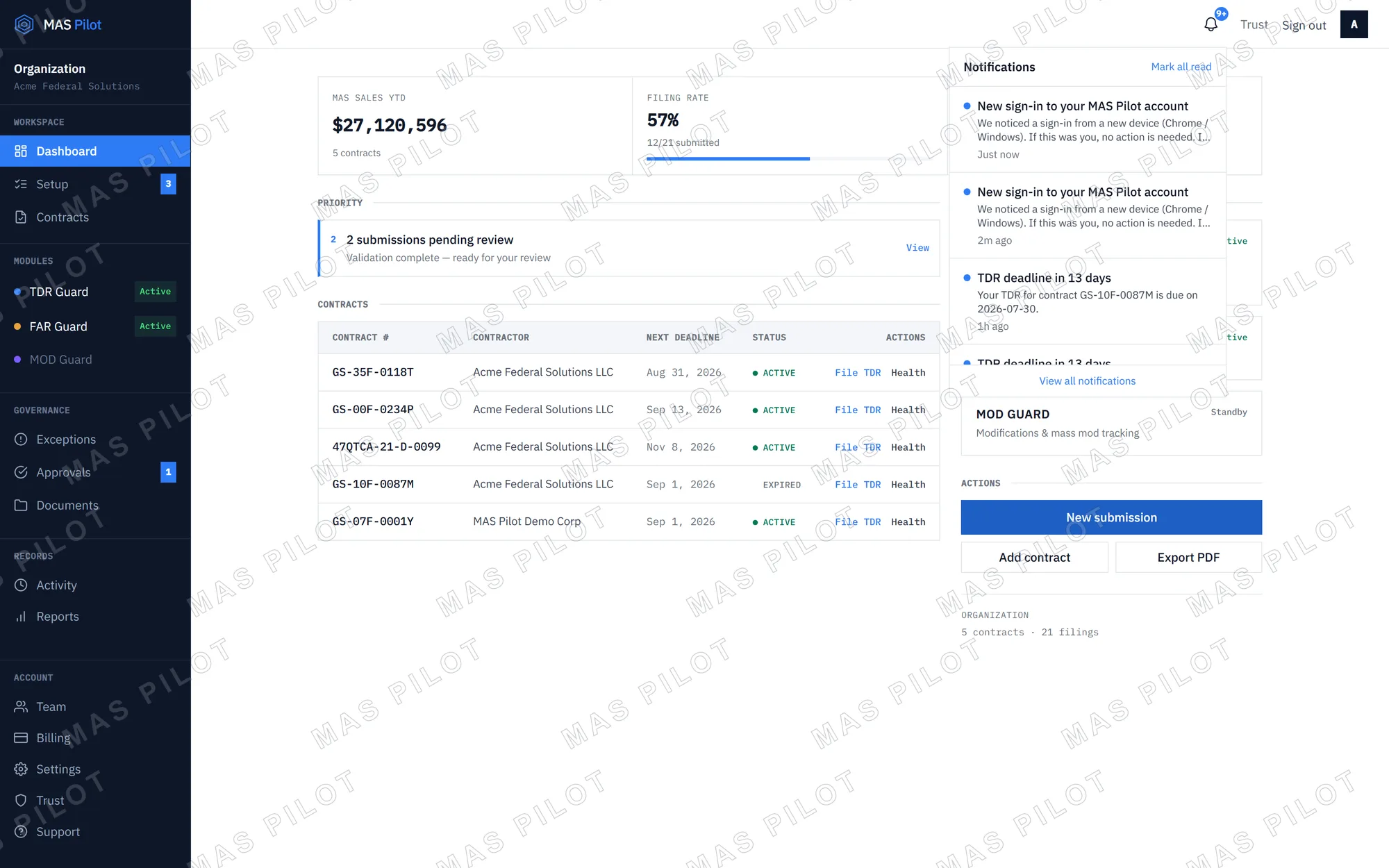
TDR Guard, available in early access from MAS Pilot, checks your monthly TDR before you submit — not just the format the SRP validates, but the compliance layer it doesn't: IFF accuracy at the rate in effect, TAA and country-of-origin, the $100K/$125K thresholds, SIN mapping, and clause applicability. It calculates IFF for your review, generates a pipe-delimited SRP export, and tracks monthly deadlines. Its findings are decision-support only — GSA makes all acceptance and compliance determinations. MAS Pilot assists with preparation; submission accuracy remains the contractor's responsibility under GSAR 552.238-80.
Wave 3 is open.
Applications under review.
We are currently reviewing contractors in early access. Accepted Wave 3 testers get their first 3 reporting periods free — a full quarter of TDR Guard and FAR Guard during the beta. Pricing and commercial terms are set when the product moves to general availability.
43 beta testers onboarded so far — Wave 1 & 2.